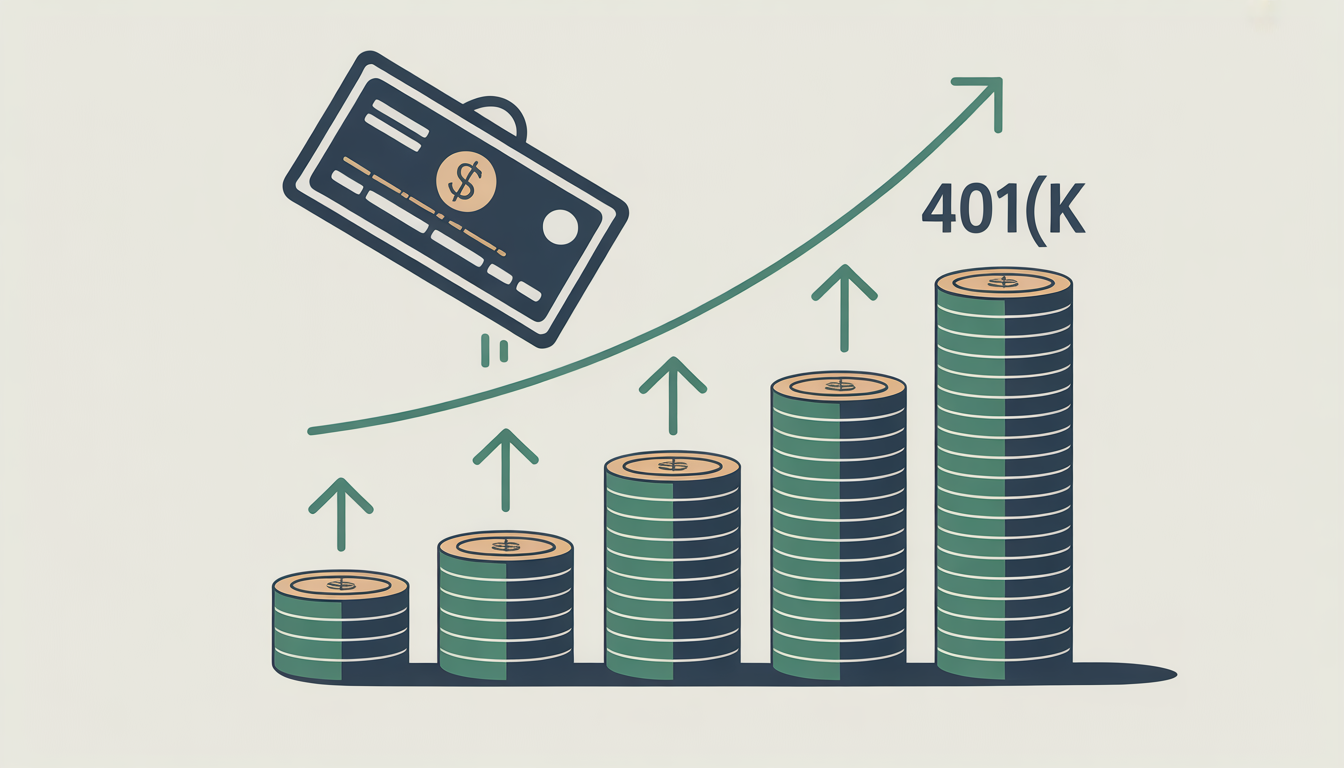
Your 401(k) is likely the most powerful retirement tool you have: money goes in automatically, it grows tax-advantaged, and many employers add free money on top. Yet most people use only part of it. Maximising your 401(k) doesn’t have to mean contributing the legal limit tomorrow. It means using every advantage the plan offers, step by step.
Key takeaways
- In 2026 you can contribute $24,500, plus $8,000 in catch-up contributions at 50 or older, or $11,250 at ages 60 to 63.
- Capture the full employer match first; it is an instant return no investment can beat.
- Raising your contribution by 1% a year adds up to a large difference without a noticeable drop in take-home pay.
- Low fees, the right Roth/traditional mix and avoiding early withdrawals matter as much as how much you put in.
2026 contribution limits
| Your age in 2026 | Your maximum contribution |
|---|---|
| Under 50 | $24,500 |
| 50 to 59, or 64 and over | $32,500 |
| 60 to 63 | $35,750 |
Employer contributions are on top of these limits. The combined cap on employee and employer money is $72,000 for 2026, plus any catch-up. Starting in 2026, if you earned more than $150,000 in FICA wages from your employer in 2025, your catch-up contributions must go in as Roth (after-tax). See 401(k) contribution limits explained.
1. Get the full employer match
A common formula is a 50% match on the first 6% of salary. If you earn $70,000 and contribute 6% ($4,200), your employer adds $2,100. Contribute only 3% and you leave $1,050 a year on the table. Find your plan’s formula and contribute at least enough to collect all of it. See how employer matching works, and check your vesting schedule before changing jobs.
2. Increase your rate a little every year
Many plans offer automatic escalation, raising your contribution by 1% each year. Turn it on, or do it yourself whenever you get a raise. Moving from 6% to 10% over four years is barely noticeable in your paycheck but can add tens of thousands of dollars by retirement.
3. Use catch-up contributions after 50
Your 50s are often your peak earning years, with lower childcare and mortgage costs. The catch-up allowance, and the higher “super catch-up” between 60 and 63, lets you put away much more in the final decade before retirement.
4. Choose between traditional and Roth deliberately
Traditional contributions cut your tax bill now; Roth contributions grow tax-free for later. If you expect a similar or higher tax rate in retirement, or want flexibility, Roth contributions can be worth more. Many people split between the two. See traditional vs Roth 401(k).
5. Keep fees low
A fund charging 1% a year versus 0.1% can cost a six-figure sum over a career. Check the expense ratios in your plan and favour low-cost index or target-date funds. See how to choose 401(k) investments.
6. Don’t break the compounding
Early withdrawals and loans that aren’t repaid cost you tax, possibly a 10% penalty, and decades of growth. Keep a separate emergency fund so your 401(k) can stay invested. See 401(k) early withdrawal rules.
7. Look for extra room
- After-tax contributions: some plans allow contributions beyond $24,500, up to the $72,000 combined cap, which can then be converted to Roth.
- An IRA alongside: you can also put $7,500 into an IRA in 2026 ($8,600 at 50 or older). See 401(k) or IRA: which to prioritise.
- A health savings account, if you have a high-deductible health plan, adds another tax-advantaged bucket.
Frequently asked questions
Is it worth maxing out my 401(k)?
If you can afford it after building an emergency fund and paying off high-interest debt, usually yes, especially in your 50s.
Does the employer match count toward my $24,500 limit?
No. It counts only toward the $72,000 combined limit.
Can I contribute to a 401(k) and an IRA in the same year?
Yes. They have separate limits, though income can affect whether IRA contributions are deductible or Roth-eligible.
The bottom line
Maximising your 401(k) is a series of small, steady moves: take the full match, raise your rate each year, use catch-ups after 50, keep costs low and leave the money alone to grow.
Want the full playbook? The Essential 401(k) & IRA Retirement Guide covers contributions, investments, rollovers and withdrawals in plain English.
2026 figures are from the IRS. This article is for education only and is not financial advice.
