
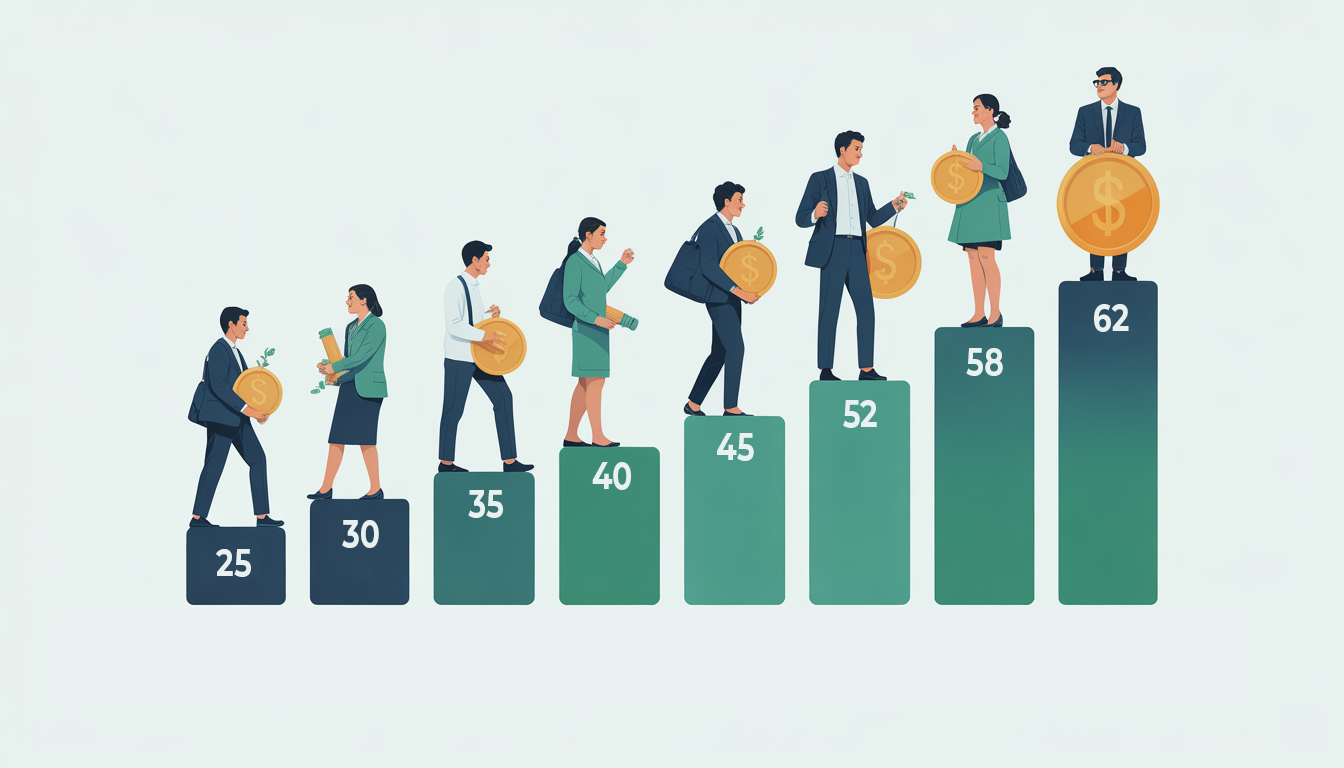
Retirement benchmarks can guide, not shame
Many people want one simple answer to the question, “How much should I have saved by now?” The challenge is that retirement savings is personal. Your income, expenses, pensions, lifestyle goals, and retirement age all influence the answer.
That said, general benchmarks can still be useful because they give you a rough sense of direction. They are not a scorecard on your worth. They are a planning tool.
Why age-based targets help
Benchmarks help you spot whether you may need to increase contributions, adjust your timeline, or review your investment strategy. They can also reassure you when you are on track or close enough that small improvements may be enough.
A simple benchmark framework
- By age 30: around 1x your annual salary
- By age 40: around 3x your annual salary
- By age 50: around 5x to 6x your annual salary
- By age 60: around 7x to 9x your annual salary
- By retirement: around 10x or more, depending on your needs
These are broad guidelines, not guarantees. They work best as conversation starters for your plan.
What to consider at each stage
In your 20s and early 30s
Your biggest advantage is time. Even modest contributions can grow significantly over decades. If your income is lower now, do not underestimate the value of consistency. Getting started matters more than starting big.
In your 40s
This is often a balancing decade. Many people are juggling family costs, mortgages, and career pressure. The goal here is usually to tighten up contributions, use employer matching fully, and avoid lifestyle inflation swallowing your raises.
In your 50s
This is when retirement becomes more real. Catch-up contributions may become available, and many savers begin paying closer attention to account balances, projected income, and withdrawal planning. Small course corrections can still make a meaningful difference.
In your 60s
At this stage, planning tends to shift from pure accumulation to income strategy. People start asking not only how much they have, but how that money will support spending over time. Risk management, taxes, and withdrawal sequencing all become more important.
What if you are behind?
- Increase your contribution rate gradually.
- Capture the full employer match.
- Review high fees and underused accounts.
- Use catch-up contributions if eligible.
- Delay retirement if that significantly improves your outcome.
- Build a more realistic post-retirement budget.
What if you are ahead?
If you are ahead of typical benchmarks, that is encouraging, but it does not mean planning is finished. You still need to think about taxes, risk, account mix, and how your retirement income plan will actually work in practice.
Do not ignore lifestyle and spending
Two people with the same balance may have very different retirement outcomes depending on how much they spend. Retirement planning is not only about hitting a number. It is about matching your assets to your expected lifestyle.
A better question than “Am I behind?”
Try asking, “What is the next smartest move from where I am now?” That mindset keeps you focused on progress instead of regret. Retirement security is often built through a series of improved decisions, not one perfect milestone.
Final thoughts
Benchmarks by age are helpful because they create perspective, but they should never be used as a source of panic. Use them as signals. Then build a practical plan around contributions, taxes, investments, and realistic goals.
For a clearer roadmap on how 401(k)s, IRAs, employer matching, growth, and withdrawals fit together, visit The Essential 401(k) & IRA Retirement Guide and view the book on your preferred online shop.
