
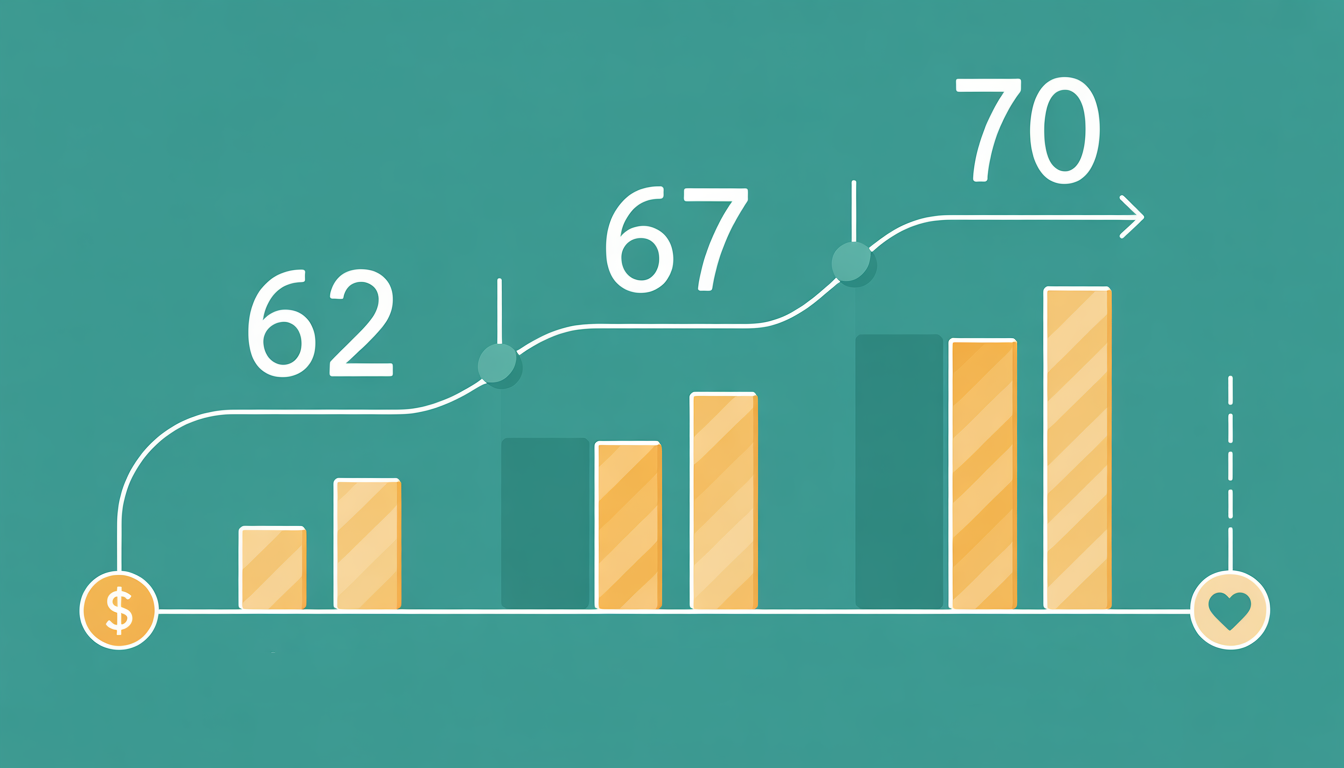
Choosing the best age to claim Social Security is one of the few retirement decisions you usually can’t undo, and it shapes your income for the rest of your life. You can start as early as 62, wait until your full retirement age (67 for anyone born in 1960 or later), or delay as late as 70. The gap between those choices is large: the same worker can receive about 77% more per month by claiming at 70 instead of 62.
This guide walks through what actually changes at each age, shows the numbers side by side, and gives you a simple way to decide what fits your situation.
Key takeaways
- Claiming at 62 permanently cuts your benefit by up to 30%.
- At full retirement age (FRA) you get 100% of your earned benefit, called your primary insurance amount.
- Each year you wait past FRA adds 8%, so claiming at 70 pays 124% of your full benefit. There is no extra credit for waiting beyond 70.
- If you live past your early 80s, waiting usually pays more over your lifetime. If you don’t, claiming earlier usually wins.
- For married couples, the higher earner’s claiming age also sets the survivor benefit, which often matters more than anything else.
What is your full retirement age?
Your full retirement age depends on the year you were born. For anyone born in 1960 or later, it is 67. If you were born between 1955 and 1959, it falls between 66 and 2 months and 66 and 10 months. Every reduction and increase is measured from this age, so it is worth confirming yours on your my Social Security account.
Claiming at 62: income now, at a permanent cost
Sixty-two is the earliest age you can claim retirement benefits. If your full retirement age is 67, claiming at 62 reduces your monthly check by 30%. The reduction is 5/9 of 1% for each of the first 36 months before FRA, and 5/12 of 1% for each month beyond that.
That reduction is permanent. It does not go back up when you reach 67, although your benefit still receives the annual cost-of-living adjustment (COLA), which was 2.8% for 2026.
Claiming at 62 can make sense if:
- You need the income and have no other savings to bridge the gap.
- You have serious health concerns or a family history that suggests a shorter life expectancy.
- You are the lower earner in a couple and your spouse plans to delay (more on this below).
Working while claiming early: the earnings test
If you claim before full retirement age and keep working, Social Security may hold back part of your benefit. In 2026, SSA withholds $1 for every $2 you earn above $24,480. In the calendar year you reach FRA, the limit rises to $65,160 and SSA withholds $1 for every $3 above it, counting only earnings before the month you reach FRA. Once you reach full retirement age, there is no limit, and SSA recalculates your benefit to credit back the months that were withheld.
Claiming at full retirement age: the middle ground
At full retirement age you receive 100% of your primary insurance amount. You can earn any amount from work without benefits being withheld, and a spouse claiming at their own FRA can receive up to 50% of your full benefit as a spousal benefit.
FRA is a sensible choice if you are in average health, have some savings but not enough to comfortably cover several years without Social Security, and want a balance between income now and income later.
Claiming at 70: the largest check for life
For every year you delay past full retirement age, your benefit grows by 8%, earned as delayed retirement credits of 2/3 of 1% per month. If your FRA is 67, waiting until 70 gives you 124% of your full benefit, plus every COLA along the way. Credits stop at 70, so there is no reason to wait longer.
Delaying to 70 can make sense if:
- You are in good health and long life runs in your family.
- You have savings, a pension or work income to live on until 70.
- You are the higher earner in a married couple and want to leave your spouse the largest possible survivor benefit.
- You worry about running out of money in your late 80s or 90s. A larger, inflation-adjusted check is one of the best forms of longevity insurance available.
62 vs 67 vs 70: the numbers side by side
Here is an example for someone born in 1960 or later whose full benefit at 67 is $2,000 a month. Figures are in today’s dollars and leave out future COLAs, which apply at every age.
| Claiming age | % of full benefit | Monthly benefit | Annual benefit |
|---|---|---|---|
| 62 | 70% | $1,400 | $16,800 |
| 67 (FRA) | 100% | $2,000 | $24,000 |
| 70 | 124% | $2,480 | $29,760 |
The break-even age
The break-even age is the point where the larger, later checks have made up for the years of smaller, earlier ones. In the example above:
- 62 vs 67: waiting pays off from about age 78 to 79.
- 67 vs 70: waiting pays off from about age 82 to 83.
- 62 vs 70: waiting pays off from about age 80.
A 65-year-old today has a good chance of living past these ages, especially women and couples, where at least one partner often lives into their 90s. That is why many planners treat delaying as the default and claiming early as the exception that needs a reason.
To run these numbers with your own benefit, use our free Social Security Claiming Age Calculator.
Married couples: why the higher earner should usually wait
For couples, the claiming decision is really two decisions, and they affect each other.
- Spousal benefits can be up to 50% of the other spouse’s full benefit if claimed at the spouse’s own FRA. Spousal benefits do not grow past FRA, so there is no gain in the lower earner delaying a spousal benefit beyond full retirement age.
- Survivor benefits work differently. When one spouse dies, the survivor keeps the larger of the two checks, including any delayed retirement credits. If the higher earner waits until 70, the surviving spouse can inherit that 124% check for life.
A common strategy is for the lower earner to claim earlier to bring in income, while the higher earner delays to 70 to lock in the biggest possible survivor benefit. Our guides to how spousal benefits work and Social Security for singles vs couples cover this in more detail.
Four questions to decide your best claiming age
- How is your health, and how long did your parents live? The longer you expect to live, the more delaying pays.
- Can you cover your expenses without Social Security until the age you’re considering? If waiting means draining savings in a way that leaves you exposed, an earlier start may be safer.
- Are you married, and who is the higher earner? The higher earner’s age sets the survivor benefit.
- Will you keep working before full retirement age? If so, the earnings test may hold back much of an early benefit anyway.
Taxes and Medicare: two things people forget
Up to 85% of your Social Security benefit can be taxable, depending on your other income. Delaying Social Security while drawing on IRA savings in your 60s can sometimes reduce lifetime taxes, because it creates low-income years for Roth conversions and lowers required minimum distributions later. See Social Security and taxes for how this works.
Medicare is separate from Social Security. You should enroll around 65 even if you delay your benefits, or you risk late-enrollment penalties.
Common mistakes to avoid
- Claiming at 62 by default without checking what you would gain by waiting.
- Thinking only about your own life expectancy and forgetting a spouse’s survivor benefit.
- Claiming early while still working and losing benefits to the earnings test.
- Assuming you can change your mind later. You can withdraw an application only within 12 months of claiming, and you must repay everything you received.
We cover more of these in 10 costly Social Security mistakes to avoid.
Frequently asked questions
What is the best age to claim Social Security?
There is no single best age for everyone. For people in good health with savings to bridge the gap, delaying to 70 usually produces the most lifetime income. For people who need income now or expect a shorter life, claiming at 62 or full retirement age is often better.
How much more do you get by waiting until 70?
If your full retirement age is 67, waiting until 70 pays 124% of your full benefit, compared with 70% at 62. That is about 77% more per month for life.
Can I claim at 62 and switch to a higher benefit later?
Not on your own record. Your reduction is permanent. You can withdraw your application within the first 12 months if you repay all benefits received, or suspend benefits at full retirement age to earn delayed credits from then until 70.
Does my Social Security increase if I keep working?
It can. SSA recalculates your benefit each year, and a year of higher earnings can replace a lower-earning year in your top 35 years. See how Social Security benefits are calculated.
What is the maximum Social Security benefit in 2026?
For a worker who has earned at or above the taxable maximum for 35 years and claims at full retirement age, the maximum is $4,152 a month in 2026. The average retired worker receives about $2,071 a month.
The bottom line
The best age to claim Social Security is the one that fits your health, your savings and your household, not the earliest date you can file. For many people, especially higher earners in good health and married couples, delaying is worth it. Run your own numbers before you decide, because this choice lasts for the rest of your life.
Want the full playbook? The Essential Social Security Retirement Guide walks through claiming strategies, spousal and survivor rules, taxes and working in retirement in plain English, with worked examples for singles and couples.
Figures are from the Social Security Administration’s 2026 fact sheet. This article is for education only and is not financial advice. Check your personal estimates at ssa.gov/myaccount.
